

Most people describe a tension headache by where they feel it: a band across the forehead, pressure behind the eyes, or a dull ache at the temples. Yet the location of a headache is often a poor guide to its source.
In many cases, the pain is being sent upward from muscles in the neck and shoulders that have been holding tension far longer than the headache itself. That connection is what makes therapeutic massage worth considering for headaches that keep coming back.
In today’s blog, we will follow that tension back to where it starts, look at how hands-on work helps release it, and explore what it can offer for migraines. So join us, and keep reading to learn more!
Can therapeutic massage help with tension headaches?
For many people, it can, largely because it works on the tissue where the pattern often begins. Tension-type headaches are the most common kind of headache and are closely linked to tight muscles in the neck, shoulders, scalp, and jaw. Small studies focused on the neck and shoulders found that participants tended to have fewer headaches over several weeks of regular sessions.
The pain and the tension can feed each other
Tension headaches can be self-reinforcing. Tight muscles contribute to pain, and pain often prompts more bracing, whether that means lifting the shoulders, clenching the jaw, or holding the neck still. Over weeks, that loop can quietly become the body’s default setting. Stress strengthens it further, and it is often how worry ends up living in your shoulders long after the stressful moment has passed.
What a session can reveal
One of the more telling moments in bodywork comes when steady pressure on a tight spot in the neck reproduces a familiar headache. That recognition points to a trigger point, a tender knot that refers pain elsewhere. Working on those spots can ease the pain they send upward, while slow, unhurried pressure signals to the nervous system that it is safe to stop guarding.
Before a session, it helps to note where and when your headaches tend to start, since those details give your bodyworker a useful place to begin.
Which neck and shoulder muscles trigger headaches?
The most practical answer starts where the pain shows up. Each of these muscles has a fairly predictable referral pattern, so a headache’s location offers clues about where it begins:

- Temples and the side of the head. The upper trapezius, the broad muscle running from the base of the skull across the shoulders, commonly refers pain up the side of the neck to the temple.
- A band wrapping from the back of the head toward the eyes. This often points to the suboccipitals, small muscles beneath the skull that work overtime when the head drifts forward, tilting it back to keep the eyes level.
- The forehead and around the eyes. The sternocleidomastoid, which runs from behind the ear to the collarbone, can send pain here, sometimes without any soreness in the neck itself.
- The top of the head. An ache at the crown is frequently linked to the splenius capitis, a strap-like muscle along the back of the neck.
Two everyday habits load these muscles more than most people realize. The first is posture: the hours spent looking down at screens keep the head held forward for long stretches. The second is breathing. When stress keeps each breath shallow and high in the chest, the sternocleidomastoid and nearby neck muscles are recruited to help lift the ribs with every inhale.
Can bodywork help with migraines too?
It can help as part of a broader plan, though its role is different. Migraine is a neurological condition, and attacks typically bring throbbing pain, often one-sided, with sensitivity to light and sound and sometimes nausea. Hands-on work will not switch that process off, but it can support the body in the time between attacks.
Neck stiffness may be an early sign of the attack
Many people with migraines notice a stiff, aching neck in the hours or even a day before the headache arrives. It is natural to assume the neck caused the attack. Often, though, that stiffness is part of the migraine’s early phase, much like yawning or food cravings can be. Knowing the difference helps set realistic expectations for what bodywork can change.
Where bodywork fits between attacks
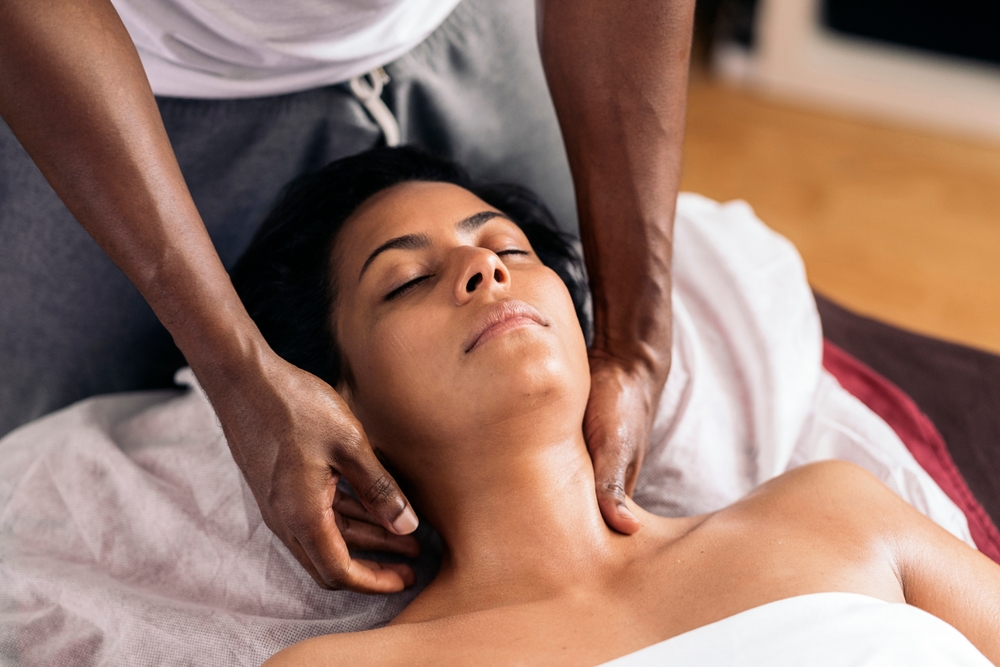 Early findings suggest hands-on work may be helpful for migraines, though the evidence so far comes from just two small studies. Much of its value seems to lie in easing stress and supporting sleep, two well-known migraine triggers.
For women whose migraines follow hormonal shifts, often alongside other pain that shows up every cycle, planning sessions around those predictable windows can be a practical approach. During an attack itself, touch and scent can feel overwhelming, so sessions are best scheduled between episodes.
Some headaches need medical attention first
Not every headache is a muscle issue. Seek medical care first for a headache that:
- Comes on suddenly and feels like the worst of your life
- Follows a fall or a blow to the head
- Arrives with fever, a stiff neck, confusion, or trouble speaking
- Brings weakness, numbness, or changes in vision
- Is new, or keeps changing and getting worse
Who can I turn to for a session of truly therapeutic massage?
Finding relief often starts with tracing the pain back to where it begins. At Oasis Healing Arts in Whittier, our bodyworkers tailor each session to the pattern in front of them, drawing on Swedish, deep tissue, and acupressure techniques in back and neck or full-body sessions lasting 30 to 120 minutes. Our aromatherapy blends were also selected with headaches and migraines in mind.
When stress, sleep, or hormones seem to be driving the cycle, Dr. Jamie Chan-Ortega and our team can look deeper through acupuncture and Functional Medicine. We welcome patients from the neighborhoods below the Puente Hills and across the surrounding communities. Schedule your first session online and start untangling the pattern behind your headaches.